
DEREK BARKA
MEET DEREK
PARTNER, CHIEF TECHNOLOGY OFFICER
As Chief Technology Officer at SilverTech, Derek defines and drives the agency’s technology vision—helping clients harness data, digital platforms, and emerging technologies to solve complex business challenges and build meaningful, lasting customer relationships.
Known for finding solutions to the toughest and most complicated technology challenges, Derek combines innovation with deep expertise across enterprise architecture, cloud infrastructure, custom development, and big data. He brings a security-first mindset and a sharp focus on privacy and compliance, enabling organizations to build secure, scalable, and future-ready digital ecosystems.
Derek serves as a strategic adviser to both SilverTech’s technology partners and clients. He works closely with platform providers—often consulting on product roadmaps—to ensure solutions align with real-world business needs and deliver maximum value. He also helps client organizations develop and execute digital roadmaps that make the most of their existing systems and data, integrating legacy technologies with modern platforms where and when it makes sense to drive growth, stay competitive, and support long-term success.
Throughout his career, Derek has played a key role in shaping the tools and platforms that power modern digital marketing. He is a recognized authority and thought leader in the martech space—recently named a Kentico MVP and Progress Sitefinity Champion. Derek holds numerous certifications, including Kentico Developer, Kentico Marketer, Sitefinity Developer, and Sitecore Developer.


What Wordle Can Teach You About Semantic Search
By: Jon Bailer | 8/31/26
The difference between finding words and finding meaning.
Have you ever played Wordle? In the unlikely event you haven't, here's a game in progress.
The gray letters are incorrect, the yellow letters are in the wrong location, and the green letters are correct. Can you tell what the answer to this game is?
If you’ve ever wondered why your website search can’t find the right content unless visitors use the exact words you expected, that’s the problem we’re about to solve. This gets a bit nerdy, but the word games make semantic search much easier to understand.
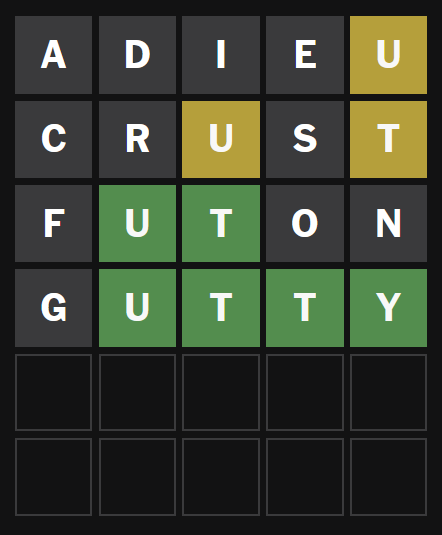
This makes sense, words are collections of letters, and games like Wordle or Hangman demonstrate the relationship. Advance to Wheel of Fortune and you can involve sentences as well. Regardless of the scale, it’s a logical way to find information, you match the letters in that information. In other words, Wordle is looking for the right letters in the right places.
Now, let me introduce you to Contexto, a different kind of word guessing game that doesn’t care about letters. Instead, the numerical value indicates how close your guess is to the meaning of a given word your guess is. Can you determine what word all of these are being compared to?
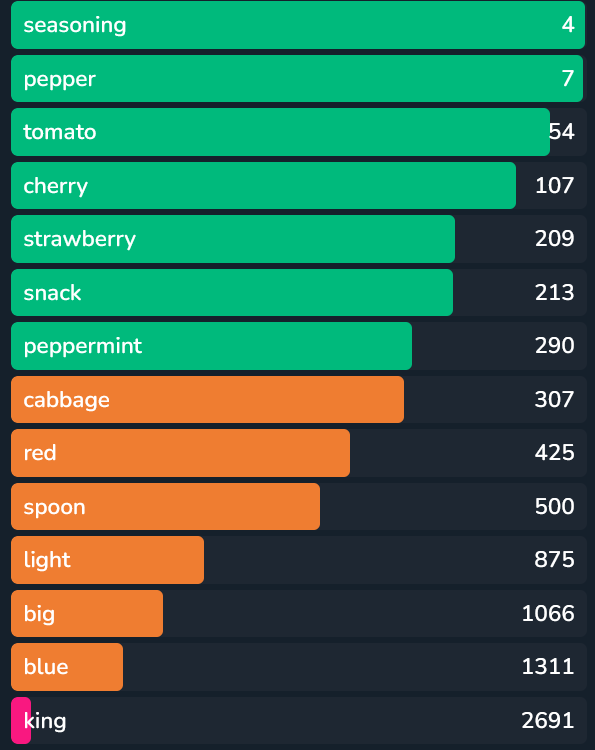
In this example the word was "spice," but what is happening?
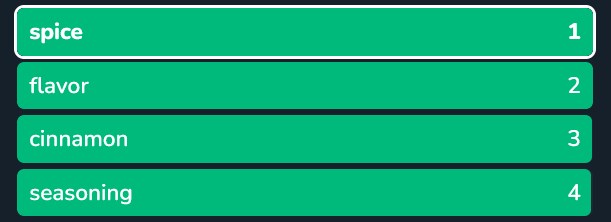
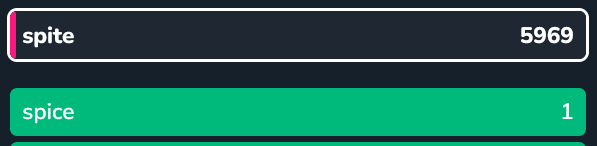
"Flavor" is closer than "spite," despite the former sharing no letters with "spice" while the latter shows all but one. That's the key difference: Contexto is comparing meaning, not spelling.
Contexto is a simple example of semantic similarity, and it’s built on the same research lineage as today’s AIs, though it is not a chatbot. The technique can determine underlying meaning and then represent that meaning as a set of numbers. Those numbers can be compared with the numbers representing other words to determine how similar their meanings are.
While demonstrated here as a simple game, I’d like to share how this technique can be scaled up to improve your content discoverability and dramatically improve your search experience. By using a technique called semantic search, powered by vector embeddings, you can craft a search that transcends keywords and even language to help your users find what they need. Put simply: Wordle searches by letters, Contexto searches by meaning, and semantic search behaves much more like Contexto.
Why Keyword Search Eventually Breaks Down
This ability to extract meaning is the gap traditional keyword-based searches are missing. A keyword search matches letters, not meaning. Someone who types “I forgot my login” may not find the “reset password” article because the phrases don’t share any keywords—even though a person immediately understands they describe the same problem. Modern search systems mitigate this by using synonym lists, content tagging, wildcard matching, and other techniques, but these techniques cost resources to maintain and aren’t without flaws.
Synonym lists can fail due to polysemy—the same word having different meanings. For example, what are the synonyms for the word “interest”? That entirely depends on which usage of “interest” I’m using, am I talking about my hobbies or my bank account? When I write “father,” do I mean my dad or my priest?
Wildcard matching can struggle to control the broadness of hits. If I search for “winter vest,” should I find content about “winter (Q4) investment strategy” because it contains the strings “winter” and “vest”? Trying to handle letter transpositions and misspellings adds another layer of complexity. What about searches in different languages? These are difficult problems for keyword-based search to solve. Instead of piling mitigation technique on top of mitigation technique, you can avoid the problem by searching a different way entirely.
From Colors to Meaning: The Nerdy Part
Let me demonstrate with colors. The display you are viewing this on can show millions of colors, but no one defined those millions individually. They’re the result of representing each color as three numbers: Red + Green + Blue, the same way the three types of cones in our own eyes work. This composite representation comes with extra benefits. We can quickly tell that RGB(214, 58, 45) and RGB(222, 52, 66) are both very red and similar, while RGB(32, 237, 161) is clearly a different, more green/blue color. You can see how natural this feels using the color comparison slider: similar-looking colors are also closer together numerically.
the color you're looking for
(214, 58, 45)
your color
(150, 150, 150)
150
150
150
how close your three numbers are
65% alike
in the same neighborhood
We can do this same comparison with language by representing words and phrases numerically according to their underlying meaning. This process is called vector embedding. It changes search into a nearness check: we find the content whose numbers are closest to the numbers representing the search. It’s just as easy for a computer to do with language as it is with colors, and the results feel just as natural to us. Imagine this simplified site content map as an example.
Pick a question, then compare how each kind of search responds:
Search method:
Fourteen help topics, arranged so questions that mean the same thing sit close together. Pick a question above to search.
We can easily see how similar concepts appear nearby by observing how different searches behave semantically versus with keywords. Astute readers will notice I didn’t show any numbers here. While colors are made up of three numbers and we know fairly well how our eyes work, language is a bit more of a mystery. Real language embedding models vary and can contain hundreds or even thousands of numbers. This visualization simplifies the concept to a two-dimensional grid, but the idea is the same even at thousands of dimensions.
What Semantic Search Solves—and Where it Doesn’t
This shift in search technique fundamentally changes a hard problem into an easier one. In fact, we’ve solved multiple hard problems with this technique. If we use semantic search, we can stop worrying so much about manually accounting for synonyms and keywords while gaining their benefits and more. Without creating and maintaining lists, we gain access to every synonym or alternate phrasing we can imagine—and quite a few we couldn’t. Numbers are language agnostic as well, so while “I forgot my login” wouldn’t find “reset password” with keywords, it can with semantic search. So can “olvidé mi contraseña,” “忘记密码了,” and any other language the embedding model supports. Furthermore, most embedding techniques use the surrounding context, so small typos, missing words, and other errors can be absorbed much as in natural conversation.
This is all pretty great, so surely there’s a catch? Semantic search isn’t better at everything. Literal matches on things like item numbers (SKUs), error codes, and proper nouns can be a struggle because we want to search for those exact terms, not some underlying meaning they carry. A search for my name (“Bailer article”) should find my blog posts, not articles about getting water out of a sinking ship. If you must pick only one, semantic search will be more effective in many situations, but the best solution is to use both and combine their strengths: exact matches where they help and semantic fallback for everything else.
There’s even more good news. Semantic search is no more expensive than many of the normal indexing and search procedures you may already be using; it’s simply a different way of indexing and searching that offers unique benefits. By indexing your content as vector embeddings, you can dramatically improve the relevance of search results you provide, even under adverse conditions like a language barrier or unfortunate spelling. There’s also a good chance you can be up and running faster than you might expect. Mostly turnkey solutions are available at nearly any scale or budget. Whether you’re looking to make search more accessible or surface valuable content that struggles to be discovered, semantic search can help—and it may be more achievable than it first sounds.
Categories:
SEO/GEO