

STUFF THAT'S GOOD TO KNOW
Digital trends and insights to stay ahead of the changing digital landscape.
Launch Is the Starting Line: Why Growth Teams Need an Ongoing Optimization Model
By: Brian Chaput | 6/12/26
How to move from website launch to continuous improvement — and why your conversion optimization strategy and digital partner make all the difference.
There is a moment most digital marketing teams know well. The redesign goes live. Leadership celebrates. The team exhales. And for a brief window, the momentum is real. Then, far too often, it stops.
Traffic plateaus. The backlog stalls. The analytics dashboard sits open in a browser tab nobody is acting on. The next project gets scoped — and the site you just built starts quietly aging in place.
This isn't a story about failed projects. Most of those launches were successful, on the terms they were evaluated. The problem is the terms. When delivery is the milestone, there is no operating model for what comes next.
The launch creates the opportunity. The system creates the growth.
The Real Cost of Launch-and-Leave
According to Gartner's CMO Spend Survey, the average organization utilizes only 33% of its martech stack's capabilities — not because the tools are wrong, but because the operating model around them hasn't kept pace. The launch happened. The sustained improvement did not.
After a major site launch or platform investment, marketing and growth teams typically hit the same familiar stalls:
Static roadmaps. Priorities set at kickoff drift out of alignment with real business needs within months — with no structured process to evolve them.
Analytics without action. The data exists. It's just not being translated into decisions.
Siloed teams. Marketing, IT, and CX operate from different definitions of success and rarely share a measurement model.
Personalization deferred. Discussed in every planning session. Rarely operationalized.
Reactive experimentation. Testing happens occasionally, not programmatically — isolated sprints that don't build on each other.
AI without foundation. Added to the stack before the underlying data and governance infrastructure is ready — adding noise instead of signal.
For organizations in regulated industries — financial services, healthcare, insurance — compliance complexity and stakeholder governance compound every one of these patterns. The cost isn't just slower growth. It's momentum lost to the gap between what was built and what is actively being improved.

From Project Thinking to Growth Thinking
Most digital organizations operate on project logic: define scope, execute, deliver, close. It's built for completion — and it delivers. But it wasn't designed for compounding improvement. The shift to an ongoing optimization model isn't about doing more work. It's about organizing the work differently — around a continuous loop of insight, action, measurement, and improvement.
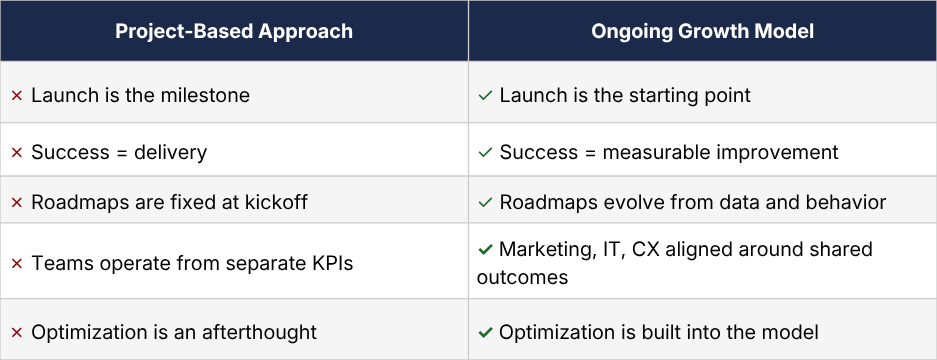
This shift requires shared KPIs across teams, measurement infrastructure that actually informs decisions, and a roadmap that evolves from real customer behavior. The foundation matters — and so does the partner you build it with. Measurement infrastructure that informs decisions isn't a nice-to-have; it's what separates organizations that compound their digital investment from those that restart from zero every budget cycle.
What Ongoing Optimization Looks Like in Practice
At SilverTech, we believe growth comes from a connected system — not a series of one-time projects. That means tying customer insight, measurement, experience optimization, personalization, digital marketing, and AI into an integrated operating model where each component supports the others.
Customer Understanding & Journey Mapping
Growth that isn't grounded in real behavior is guesswork. Journey research, voice-of-customer analysis, and behavioral data reveal where digital experiences break down across actual user paths — and where the highest-value improvements live.
-.jpg?sfvrsn=fd954051_2 "Example Customer Journey Map 3 (2)-")
Example Customer Journey Map
KPI-Aligned Roadmap & Measurement
The fastest path to progress isn't doing more — it's aligning the right people around the right priorities. Structured alignment workshops translate business goals into measurable action. Attribution modeling, connected dashboards, and CRM visibility create the decision-ready reporting that lets teams act on what they're seeing — not just observe it.
Experience Optimization & CRO
Conversion optimization, UX improvements, content testing, and A/B experimentation — done continuously, not as a one-time sprint. The value of programmatic conversion optimization is the compounding effect: every learning informs the next iteration. The results speak for themselves. A financial services calculator optimization SilverTech ran produced approximately 40% higher conversion at 95% confidence. A single CTA language change increased clicks from 1 to over 200 per 1,500 visitors. Neither outcome came from a one-time audit — they came from a structured CRO engine running continuously against real behavior.
Personalization & AI
Personalization is discussed in nearly every digital strategy conversation — and operationalized in relatively few. The gap isn't vision, and it isn't the technology. The platforms have been capable for years. What stops most organizations is the complexity underneath: data they don't fully trust, governance structures that create decision paralysis, and siloed systems that can't assemble a coherent picture of the customer. Most personalization programs don't fail at the technology layer — they collapse under the weight of everything the technology exposed that wasn't ready.
Salesforce's State of the Connected Customer report found that 73% of customers expect companies to understand their unique needs — yet fewer than 1 in 3 organizations have delivered on it. St. Mary's Bank is one that has — working with SilverTech to build a personalized member experience grounded in customer insight and first-party data strategy. AI accelerates the system when that foundation is in place. Without it, AI adds speed to the confusion.
The Optimize Partner Plan
SilverTech’s Optimize Partner Plan is the model that keeps it all running: a flexible, retainer-based partnership that gives organizations ongoing access to a cross-functional team — with quarterly roadmaps, shared KPIs, and built-in accountability. Organizations that value ongoing optimization — not a series of projects — are more likely to realize measurable progress.
Growth needs a system, not a series of disconnected projects. And that system needs a partner with shared accountability — not just shared deliverables.
A Quick Self-Assessment
Before looking at how to move forward, it's worth an honest look at where your organization stands today:
• Does your team have a shared KPI framework that marketing, IT, and CX all operate from?
• Are your analytics informing decisions regularly — or being reviewed without clear action?
• Is your website optimization work programmatic, or reactive?
• Does your current digital partner have accountability built in — or does the relationship end at delivery?
Where you see gaps, that's where ongoing optimization creates the most immediate value.
| Ask Us About… | |
|---|---|
Flexible retainer-based partnership — ongoing access to strategists, designers, developers, and marketers. Quarterly roadmaps, KPI tracking, and budget flexibility that is built in. | |
MAP Workshop | A structured Meet-Align-Prioritize session that helps leadership teams align on goals and build a KPI-driven digital roadmap — fast. |
CMS/DXP ROI Assessment | A diagnostic that evaluates whether your current platform investment is set up to support ongoing optimization and personalization — or structurally limiting both. |
A structured CRO engagement combining behavioral analysis, experimentation, and AI-driven prioritization to improve conversion across key digital journeys. | |
A guided, low-risk starting point for organizations ready to move from personalization ambition to measurable results — in weeks, not quarters. | |
The launch created the opportunity. The question now is whether you have the system — and the right partner — to capitalize on it.