
APPLIED AI STRATEGIES
DRIVE GROWTH WITH STRATEGIC AI BUILT ON YOUR DATA
The question isn't whether to use AI, it's how to use it effectively. SilverTech helps organizations turn their data into real business outcomes by putting AI and machine learning to work in ways that make a difference. This includes creating more personalized digital experiences, improving search and chat, and using predictive analytics to anticipate customer needs. With the right data strategy, you can leverage AI and machine learning to automate processes, uncover trends, and make smarter decisions at scale, today. It's not about chasing hype; it's about using the data you already have to work smarter and move your organization forward.
CORE CAPABILITIES
- Data Modeling
- Data Integration
- AI Personalization
- AI Analytics & Insights
- Conversational AI
- Site Search
- Security Monitoring
- Recommendation Engines
- Custom AI & LLM Solutions
-(3)-(1).jpg?sfvrsn=85a5da93_0)
LIVE CHAT: HOW AI-POWERED PERSONALIZATION TRANSFORMED INDEPENDENT BANK'S DIGITAL EXPERIENCE
Learn how Independent Bank transformed their digital experience with AI-powered search & personalization, achieving a 400% increase in business banking site traffic, 169% increase in total users, and 98% increase in sessions all in under 6 months.DON'T JUST TAKE OUR WORD FOR IT
We partnered with SilverTech to rebuild every layer of our website, architecture, design, content, and functionality. We introduced predictive analytics, AI-powered search, and fully integrated support, making banking easier, faster, and more personal. Since launch, we’ve seen longer sessions, more engagement, lower bounce rates, and fewer support calls. But most importantly, we’ve built a site that finally reflects who we are: the bank of YOU.
Mindy Dyk, Vice President of Digital Marketing
Independent BankADVANCING DIGITAL MATURITY THROUGH DATA AND MACHINE LEARNING
Fulton Bank partnered with SilverTech to elevate its digital maturity by unlocking the full potential of its first-party data. SilverTech merged demographic, transactional, and behavioral data with machine learning predictions to create dynamic, personalized web experiences. Using a phased approach, they delivered tailored journeys, targeted promotions, and next-best product recommendations. The enhanced data infrastructure now powers more intelligent, personalized engagement across all digital channels.

GENERATIVE ENGINE OPTIMIZATION (GEO) VS. TRADITIONAL SEO: THE FUTURE OF SEARCH AND CONTENT STRATEGY
How does GEO align with SEO, and how does it differ? Check out our blog to find out how you should optimize your content for both traditional and AI-driven searches.FAQs
What is Content Modeling? A Guide to Structuring Content for Success
5/23/25
Content is everywhere — websites, apps, marketing campaigns, chatbots, and more. Behind every piece of content that looks clean and well-organized is an intentional content model guiding how that content is created, stored, and displayed. Whether you are a developer, designer, marketer, or content strategist, understanding content modeling is essential to building scalable and effective digital experiences.
What is Content Modeling?
Content modeling is the process of identifying, organizing, and structuring all the distinct types of content an organization needs — and defining how these pieces relate to one another. Think of it as creating a blueprint for your content, much like an architect creates a blueprint for a building. A content model breaks content down into content types, fields, relationships, and ensures that content is reusable, adaptable, and easy to manage across multiple platforms and channels. Why is Content Modeling Important? Without a clear content model, content can become fragmented, inconsistent, and difficult to manage. Here’s why content modeling should be a cornerstone of your content strategy:
• Consistency: Ensures that content is structured uniformly across all platforms.
• Scalability: Makes it easier to add new content types or adapt to new channels without starting from scratch.
• Reusability: Allows content to be repurposed for different contexts (e.g., websites, apps, voice assistants)
• Collaboration: Helps designers, developers, and writers work from the same content blueprint, reducing confusion and errors.
• Future-proof: Prepares your content to be flexible and ready for future technologies and platforms.
Key Elements of a Content Model
1. Content Types
These are the different kinds of content you need, such as "Blog Post," "Product," "Testimonial," "Event," or "Author."
2. Fields/Attributes
Each content type has specific pieces of information (fields) associated with it.
• For a Blog Post, fields might include Title, Author, Publish Date, Body, Tags, and Featured Image.
• For a Product, fields might include Name, Description, Price, SKU, and Image.
3. Relationships
Content types often relate to each other.
• A Blog Post might have a relationship with an Author.
• A Product might be linked to multiple Categories.
4. Content Rules
These are constraints and guidelines that ensure content is created correctly.
• Example: "The Title field is required and has a 60-character limit."
• Example: "An Event must have a Date and Location."
5. Taxonomies and Tags
To classify and group content logically, you may define categories, tags, or custom taxonomies (e.g., genres for books).
A Simple Example: Modeling a Blog Post
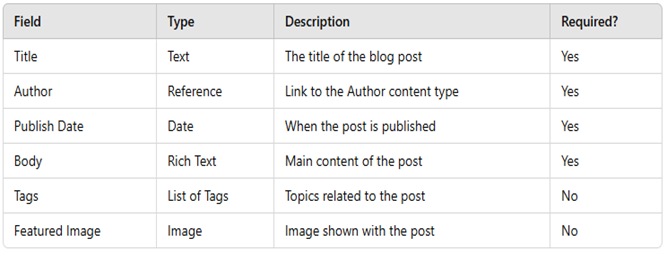
How content Modeling Helps Teams
• Content Strategists: Plan and organize content in ways that align with business goals.
• Designers: Know exactly what content elements are available to design for.
• Developers: Can build flexible and efficient content structures in CMS or headless CMS systems.
• Marketing Teams: Ensure consistent messaging and design across campaigns.
Content Modeling in a Headless CMS World
What is Content Modeling? <p><b>Content modeling</b> is the process of identifying, organizing, and structuring all the distinct types of content an organization needs — and defining how these pieces relate to one another. Think of it as creating a blueprint for your content, much like an architect creates a blueprint for a building.</p> <p>A content model breaks content down into <b>content types, fields, relationships</b>, and <b>rules</b>, ensuring that content is reusable, adaptable, and easy to manage across multiple platforms and channels.</p> <h2>Why is Content Modeling Important?</h2> <p>Without a clear content model, content can become fragmented, inconsistent, and difficult to manage. Here’s why content modeling should be a cornerstone of your content strategy:</p> <p style=">With the rise of headless CMS platforms like Sanity and Contentful and hybrid headless CMS platforms like Kentico and Progress Sitefinity, content modeling has become even more critical. Since content is decoupled from presentation, having a solid model allows you to reuse the same content across websites, mobile apps, and even IoT devices without reauthoring content.
Tips for Effective Content Modeling
• Start with a Content Inventory: Identify all content types and their variations.
• Think About Relationships: Map out how content pieces connect.
• Consider Reusability: Design models that allow content to be reused in multiple contexts.
• Involve Stakeholders Early: Collaborate with developers, designers, and marketers to ensure the model works for everyone.
• Document Everything: Create clear documentation so everyone understands the content structure.
A Complex Example: Website Content Model
A complex content model for a website ensures structured content management, facilitating scalability, personalization, and multi-channel publishing.
[Home Page] ---> [Services] ---> [Case Studies]
| | |
V V V
[About Page] <--> [Team] [Testimonials]
|
V
[Contact Page]
Services Example
• GET /services – Get all services
• GET /services/{id} – Get a specific service
• POST /services – Create a new service
• PUT /services/{id} – Update a service
• DELETE /services/{id} – Delete a service
"id": 1,
"name": "Web Development",
"description": "Custom website development services.",
"category": "Development",
"icon": "https://cdn.yourbusiness.com/icons/web-dev.png",
"pricing": "Contact for Pricing",
"related_services": [2, 3]
Final Thoughts
Unlock the full potential of your digital ecosystem with SilverTech’s Content Modeling Solutions. Content modeling is more than just a technical task — it is a collaborative effort that ensures your content is consistent, flexible, and ready to meet user needs. Whether you’re managing a dynamic website, powering omnichannel marketing, or streamlining content governance, our expertly crafted models bring order to complexity.
A strong content model will set you up for success. We design flexible, future-proof structures that empower teams to create, manage, and distribute content seamlessly—reducing redundancies, improving searchability, and accelerating time-to-market. With SilverTech, your content isn’t just organized, it’s optimized for engagement, innovation, and business growth.
Ready to create a content model? Don’t delay! Get in touch to discover how SilverTech’s content modeling solution can make it happen.